

Swiss artist Elisabeth (Lisa) Bottesi, based in Oetwil am See, has developed over the past forty years a distinctive and independent artistic language by challenging classical symmetry, the richness of ornamentation, and the use of black and white.
Originally from Troyes in France, Emmanuel Fornage, for his part, explored paper cutting with scissors as a narrative art form. Inspired by landscapes and tales, he created poetic scenes populated with small stories, in keeping with a living tradition spanning Switzerland and Europe.
Two complementary approaches—between tradition and modernity—that celebrate the richness and creativity of paper cutting.
ELISABETH BOTTESI
Elisabeth Bottesi was born on June 25, 1960, in Gstaad. She has been fascinated by the art of paper cutting (Scherenschnitt) since childhood. She began with traditional black paper cuts and motifs and was introduced to the art by Christian Schwizgebel, whose works are renowned far beyond Switzerland’s borders.
Since 1992, she has developed a special technique for creating colorful, three-dimensional paper-cut collages. These vibrant, three-dimensional compositions have become her signature style. Since 1981, her artworks have been regularly exhibited not only in Switzerland but also internationally.
Lisa works in her bright studio, seated at a large table. Through the window she can see lush blooming flowers and an elder tree. Working in the garden and going for jogging runs provide a balance to the focused and sedentary nature of her artistic work.
She reaches into an open box and selects a green sheet of paper. “These are all colored pages from magazines that I keep, because only photographed images are lightfast and therefore suitable for my paper-cut collages,” she explains.
From these colored papers, she spends countless hours cutting flowers, leaves, grasses, and other elements. Using tweezers and a small glue brush, she carefully attaches them to a previously prepared black paper cut.
The glued grasses often resemble feathers. She arranges them so that they stand slightly away from the surface, creating a three-dimensional effect.
Over the past forty years, the paper-cut artist from Oetwil am See has developed a distinctive originality and independence, precisely because she has questioned the traditional symmetry, rich ornamentation, and black-and-white conventions of the craft.


A few days before the opening of his exhibition, Emmanuel passed away suddenly. Through this exhibition, we wish to celebrate his work and pay tribute to him.
EMMANUEL FORNAGE
His name was Emmanuel Fornage.
He lived in Troyes, in the Champagne-Ardenne region, and invites you to discover his world, filled with small stories and landscapes created through paper cutting.
Paper cutting is an art form that is little known in France, yet extends far beyond its borders. In Switzerland, it is often used to highlight mountain landscapes and alpine traditions. It can also be found in Germany, the Netherlands, and in Eastern Europe.
In his life, he was a primary school teacher, married, and the father of two children.
In 2005, during a stay in Château-d’Œx in Switzerland, he discovered the art of paper cutting with scissors following a health issue.
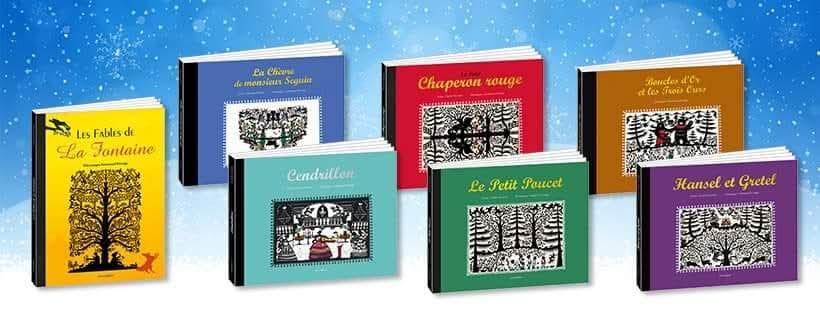
From 2010 onwards, he worked on seven books for Circonflexe publishing: one on La Fontaine’s Fables and six others on traditional tales.


Extension of the exhibition until July 5, 2026 for the Paper Cutting Days.